McKinsey on Agentic AI:
How to Create Business Value
Although companies spend heavily on AI, few capture its value, according to McKinsey QuantumBlack. Their global leader explains why and shares a repeatable process for enterprise and agentic AI.
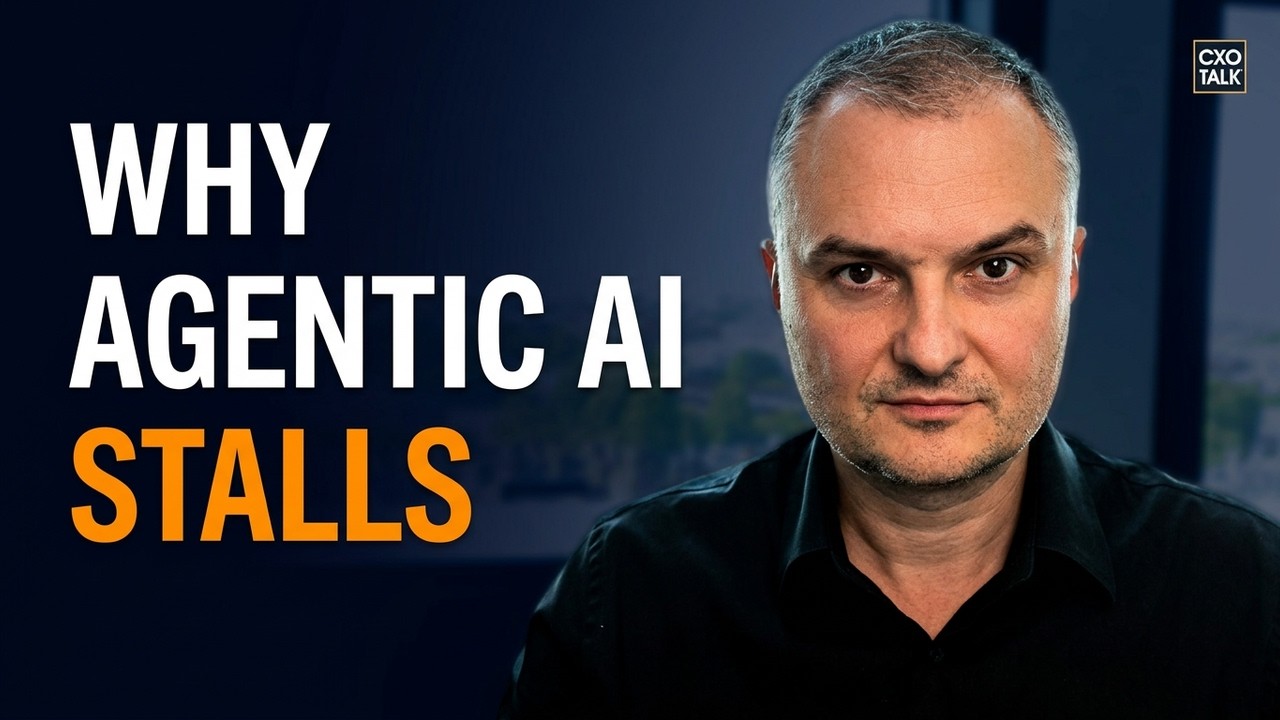 Watch on YouTube
53:35
Watch on YouTube
53:35 

This episode is brought to you by Gartner IT Symposium/Xpo™
Ready to scale agentic AI from pilot to production? Join top CIOs and IT executives at Gartner IT Symposium/Xpo, taking place this October 19th through the 22nd in Orlando, Florida.
Over 300 Gartner analyst-led sessions will cover top priorities shaping IT—from AI value, governance, and cybersecurity to cost optimization, IT operating models, and beyond.
Get practical, actionable insights—and connect with peers tackling the same challenges you are.
Secure your spot today at gartner.com/us/symposium.
In 2026, enterprises are pouring money into AI, yet fewer than 100 companies have captured most of the value. McKinsey's QuantumBlack, which advises many of the world's largest companies, finds the winners reinvented a few core domains instead of buying more tools. This conversation lays out that repeatable recipe: which domains to focus on, how to ready data and architecture, why the CEO must lead, and why agents are colleagues, not tools.
Key points:
- Reinvent a few core domains end to end rather than layering AI onto existing processes; the winners focus rather than spread thin.
- Treat AI transformation as a CEO-led, board-level effort, with technology leaders guiding and teaching rather than owning the business strategy.
- Plan governance, data access, and economics for a hybrid workforce where agents work alongside people as accountable colleagues, not tools.


The value of agentic AI comes from redesigning work, roles, and accountability, not from better tools. In CXOTalk Episode 922, Alexander Sukharevsky, Global Leader of QuantumBlack, AI by McKinsey, joins Michael Krigsman to examine why so much AI investment has yielded limited measurable value. The discussion explores how companies can move from pilots and automation to AI-enabled operating models that deliver business impact.
Sukharevsky also takes on the leadership choices behind agentic AI adoption: where workflows must change, how human roles evolve, and what CEOs must own directly. For senior executives, the key concern is not just the power of AI agents but whether the organization can deploy them with sufficient trust, control, and speed to make an impact. an impact.
What we will cover:
- Why agentic AI value remains hard to measure despite heavy investment
- What leaders misunderstand about capturing value from AI
- How to redesign workflows around AI agents rather than attach AI to existing processes
- Why AI capability cannot be outsourced
- How agentic AI changes professional work, entry-level roles, and the path to expertise
- What CEO ownership of AI looks like when balancing trust, control, and speed
Watch CXOTalk Episode 922 with Alexander Sukharevsky, Global Leader of QuantumBlack, AI by McKinsey.
Episode Participants
Alexander Sukharevsky is a global leader of QuantumBlack, AI by McKinsey, which helps organizations redefine business models and improve performance through the responsible use of AI and technology
Michael Krigsman is a globally recognized analyst, strategic advisor, and industry commentator known for his deep expertise in business transformation, innovation, and AI leadership.
In This Episode
The invariant recipe for AI value
Michael Krigsman: Less than 100 companies so far have captured more than 2/3 of the value. They did it in two or less domains with one to three return ratio. Companies spend billions chasing AI. Few find value. Alexander Sukharevsky leads QuantumBlack, McKinsey's AI practice, advising the world's largest companies.
Alexander Sukharevsky: It's really about an holistic approach, focusing on a few domains and trying to reinvent them, finding the right data to power this reinvention, aligning your architecture, finding the right talent, and upskilling the rest of the organization, changing your operating model, as well as focusing on economics. And what we try to do is look across thousands of transformations across the globe and then focus on ones that made it in order to understand what is the right recipe. And when you look under the hood, it's quite fascinating. So first of all, it's invariant.
There is only one way to go in terms of different elements of the journey. And then since you have quite a few elements, and it's not about picking and choosing one of few of them, but rather having all of them in place, statistically it becomes very difficult, and therefore, happy to elaborate on this element, having them all in place in order to unlock value is difficult. If you miss one or a few of them, the value is not getting unlocked.
Michael Krigsman: This episode is brought to you by Gartner IT Symposium/Xpo. Ready to scale agentic AI from pilot to production? Join top CIOs and IT execs this October 19th to 22nd in Orlando, Florida. Over 300 Gartner analyst-led sessions will cover top priorities shaping IT, from AI value, governance, and cybersecurity to cost optimization, IT operating models, and beyond. Get practical insights and connect with peers tackling the same challenges you are. Secure your spot today at gartner.com/us/symposium. That begs the question, what are those elements that must be in place to unlock the value that AI brings?
Alexander Sukharevsky: All the companies that managed to get boost of at least 20% on their bottom line or the overall value of the company actually went through this journey. So step one, you need to think about what are the core domains that you would like to transform, and any business has a limited number of domains that are creating most of the value. And if you look at the numbers, what you see is that the companies that transformed themselves actually focused on 2 or less domains. So it's really about focus.
But then the important part is not just infusing technology within the current business model, but thinking about complete reinvention. So what would it mean to deliver the same value for a few cents on every dollar as opposed to spending $1 on the same process? How I can boost my revenues, not just 10 or 20%, but 2 or threefolds? How do I improve my customer experience in a radical way that nobody could imagine before?
So it's literally about taking your most talented colleagues, putting them in the room, teaching them technology, and then trying to reinvent domains and deciding which domains you would like to focus. And this step is absolutely crucial before you go on the journey. Once you figured out what are the domains, you ask yourself, "Do I have enough data in order to unlock the vision that has been just created?"
And there is no situation when there is a perfect data, so you should understand what do you have today, what you might have tomorrow, and what do you need to do in order to get it tomorrow, and what data you will never have just by the nature of it. And therefore, it's important that you focus on repeatable data products in order to power the domain transformation you are going after. Once you decided on the data product, the question is, what is the current status of your architecture?
Because you need to allow the data to flow, and in many cases, it sounds very technical questions, but actually it's the CEO question because it's about the distribution of power and influence within the organization, and also has a lot of politics inside. So the question is, how do you rewire the architecture and how do you bring your vision into life and being able to use all these amazing new tools that come into the market every day?
Now, once you've thought about it, the question is, what are the other parts of your technology stack, starting from the foundational model, but also around compute, in order to power the transformation you are going after? Now shifting gears toward the human stack, the question is, do you have relevant and competent technology colleagues who will be helping you during the journey? But then not less important question is, how do you bring these colleagues into the more traditional organization? How do you provide them the right incentives? How do you ensure that they stick around?
But then there is another part of the same coin is really how to ensure that rest of the organization getting familiar and confident about using technology, be it AI or be it any other technology. And these are colleagues, most of whom have never studied computer science. They are coming from very different backgrounds, but they need to learn how do you operate with technology.
Once you did it, there is a huge part that has to do with change management because what we are doing here, we are changing the way colleagues are working, we are changing our operating model, we are changing managerial models. So the change management is absolutely crucial in order to ensure that we are able not just to get an incremental impact, but clearly rewire the enterprise. And then there are two other elements that are absolutely crucial, and one of them is around governance and operating system, because you clearly cannot govern it in the more traditional way.
Because we're in the world where you have not just human colleagues, but also agents working with humans together, what does it mean? How do you operate such an enterprise? So your governance should be very different, as well as some of the managerial practices. While some of them remain the same, because the core of being a good manager is still relevant here. And then the last bit is that connected to the first step of deciding on the domain, is being very clear around economics. So what are you trying to achieve? What are the objectives?
What is the really business case in order to achieve this objective? And when I am saying business case, it's not just about technology, investment in technology, it's also about what are you going to invest in upskilling your colleagues? What is the overall cost? And then thinking that you're going for really radical change as opposed to incremental change. Now, what I mentioned, so think about the reinventing domain, having the right data in place, rewiring architecture, dealing with best talent and upskilling existing talent, changing the governance model, and thinking about the economics in a different way.
Now you need to make them all work, and that leads to your first question, why most of the organization are having difficulties to ensure that the impact is coming with all the efforts of digital transformations.
Treat agents as colleagues, not tools
Michael Krigsman: Talk about the impact of agentic AI, of AI agents, and what does everything you just described mean in that context?
Alexander Sukharevsky: If you look at our Rewired research, the first book came free, it came out 3 years ago, pretty much at the same time where ChatGPT was released. And then this April, we released the update with all the implication, what does it mean in, for the world of agents? Now, the interesting piece is that the fundamentals remain, and it just reinforced our belief that the recipe that I described is relevant and, frankly, becoming even more relevant within the agentic world.
What I mean by this, that in order to capture value from any technology, AI, whatever you call it, transformation, you actually need to have the basic chassis right, and then irrespectively of technology, you will be able to scale and get value from technology. And that's point number one. So the recipe that we just discussed becomes even more relevant. And if you look at the companies in our book that featured in the 1st edition, some of them are the leaders in the 2nd edition because now they apply agentic using the same chassis.
Now, the fundamental difference that I see today, and it becomes obvious, that agents are not an additional tool we use. You could think of it as another colleague that augments what our organization does. So the future competitive advantage of organization is going to be clearly human beings, clearly agents, clearly right data, clearly right business model, and right judgment and performance management coming together in order to win. So the only thing that it means that the organization became much more complex, and you should not treat agents as another tool, but rather as a colleague.
Michael Krigsman: This episode is brought to you by Gartner IT Symposium/Xpo. Ready to scale agentic AI from pilot to production? Join top CIOs and IT execs this October 19th to 22nd in Orlando, Florida. Over 300 Gartner analyst-led sessions will cover top priorities shaping IT, from AI value, governance, and cybersecurity to cost optimization, IT operating models, and beyond. Get practical insights and connect with peers tackling the same challenges you are. Secure your spot today at gartner.com/us/symposium. Let's jump to some questions.
Rabi Hassan is the first, the first brave one, the brave one with the first question, and he says, "If you were building a data and AI platform from scratch today, what would you prioritize first? Model quality, proprietary data, workflow integration, or user adoption? Which of these creates the most durable competitive advantage over the next decade?"
Alexander Sukharevsky: The difficult part, that it's not about choosing one of them, but actually having all of them in place. And I know that's not the answer that you were looking for, but essentially what we learned in our research, that unless you have all of them lined up you won't be able to unlock the value. Now, having said that, based on my experience working with a lot of enterprises across the globe, I think the adoption part is the difficult one, as well as the definition of the right domains.
Because in many times, we see a quest toward creating the perfect technological platform, creating the perfect data lake, and trying to assemble all data together. However, at the same time, it's done in a very encapsulated way within the technology organization, and the difficult questions around domain reinvention and also domain focus, as well as engagement of rest of the organization using the platform and some of the amazing tools the technology department is developing, is not necessarily in place.
And therefore, if I were to look where most of the transformations have been some of the difficulties, it's really about how do you bring these two worlds together, of platform thinking but also users that frankly a few years ago couldn't understand what platform means and struggle to use most of the tools that are available even today.
Michael Krigsman: It's such a very interesting and insightful point that you made about technology organizations trying to build the perfect platform, to architect the perfect system. And then Alexander, you're saying that's not the real source of value.
Why the CEO must own the transformation
Alexander Sukharevsky: Correct. And I truly believe that the transformation should be driven by the CEO and the board. Because if it is driven just by the CTO or chief digital officer, what we see in most of the cases, it's ends up with a lot of amazing pilots that frankly show impact. It also ends up with a lot of interesting technology solutions and very advanced platforms, but it does not bring to the full change of the organization and the rewiring the organization. And therefore, the person who should be chief transformation officer is the CEO of the organization.
Michael Krigsman: In effect, I don't mean to put words in your mouth, what you're saying are the technologists, whether it's the CIO, chief digital officer, so forth, can lead the organization essentially down the wrong lesser value path, and it's the CEO who has to ensure that the correct value path is being followed. Is that a correct way of saying it?
Alexander Sukharevsky: I would be slightly more precise saying that it's about CEO being at the leading role driving the transformation, because she or he knows exactly what organization needs. She or he are the most competent people within the organization to understand the strategy, the direction of travel, investor expectations, the market evolution. But at the same time, CTO or CDO, CIO has extremely important role to guide the CEO and her and his team around the main topics. Actually educate them about the art of possible. Explain what are the bottlenecks.
So it's extremely crucial role, but as part of the team, however, the lead should be coming from the business side and not from the technology side. And good CEO, CDO is not going to take the organization at the wrong way, but rather guide rest of the team and show the art of possible as well as pragmatic limitation to the status quo that the organization experiences.
Michael Krigsman: All of these various aspects you were describing then get represented by the various members of the team who are contributing to the CEO's fuller understanding and ability to therefore make the right decisions. Is that correct?
Alexander Sukharevsky: Correct. And I think what we found in an interesting way consistently across our research that we call the State of AI, that the organizations that manage to do so successfully have a full board being extremely savvy and fluent around various technology topics. So you could, to Michael, to your, to your point, different board members first studied technology and then applied technology and led domain transformation within their respective areas of responsibility, guided and supported by CDO, but they were in the driving seat.
And the notion of the board learning to understand technology, learning to understand the language, and literally driving it not only on, at the inspirational and target-setting level, but rather on the daily level of sprints, product feature selection, budget reallocation, de-bottlenecking various issues that might appear, that's the right way to approach it, as opposed to outsource it to CDO and ask her to help you.
Michael Krigsman: So you're really proposing a very hands-on perspective of both the board and the CEO. I would say more hands-on than we might typically expect.
Alexander Sukharevsky: It's a very personal journey, so just getting a membership is not enough. Just getting a great coach is not enough. If you would like to achieve certain results, and each one of us has different expectations, you need to do it yourself. And the same happens here. And unless you start upskilling yourself, and you start using the tools, you start learning the language, and you start changing the way you work and operate, it will be very difficult to drive enterprise towards significant change.
From token maxing to value maxing
Michael Krigsman: Swami Vaidyanathan says, "Do you see a dial-up or a pause in AI investments from CXOs?" After the AI governance challenges with the story shifting from token maxing to value maxing.
Alexander Sukharevsky: What I'm seeing today is better understanding of economics and looking first and foremost on what we are trying to achieve. And frankly, if we go back, that's in basics of any managerial theory, the notion of defining the right goal and the way you measure it while understanding the context becomes even more important because, Michael, to your previous question around the agentic world, if you define the wrong objective, it's not only going to create chaos, but it's going to be executed very fast at the wrong direction. So the same goes to economics.
You see more and more organizations having a very robust view in terms of, number one, picking up the domains where you would like to apply AI, and number two, looking at the overall economics of doing the transformation. So think of it not only tokens, but also investment in human capital, investment in other parts of the technology organization, investment in change management. So you really need to combine the full business case.
And the good news, if you look at the winners, what you realize that ROI is pretty much going to be one to three, meaning on every dollar invested in transformation, the return is around $3. So it's quite fascinating in terms of very high returns, but you should be extremely focused and honest with yourself once you prepare the business case.
Michael Krigsman: The pattern that I'm seeing here is my questions and the audience questions are tending to focus on specific aspects or attributes, and you seem always to be rising to a high, to the, to the broader level, looking at it holistically, saying. Again, I'm not trying to put words in your mouth, but essentially saying you need to have all of these pieces in place if you want to capture the value and be successful with AI.
Alexander Sukharevsky: Absolutely, and we might like or dislike it, but we looked at, I think, the largest empirical sample globally over 6 years, and this is what it says. And if you look under the hood, what you realize is that essentially out of these thousands of transformations, less than 100 companies so far have captured more than 2/3 of the value. And as I said, they did it in two or less domains with one to three return ratio.
And therefore, if you look at these companies, what you realize that if you go into separate sleeves or aspects of the transformation that are extremely important, you might win certain efficiencies, but it's not going to rewire the enterprise and bring the returns that I just raised, unless you do the full monty and go into the all elements that we described before. So unfortunately, there is no easy way going there. But what is interesting, once you establish the chassis, the likelihood of success is getting closer to 80, 85%.
So meaning it's really difficult to move few first domains, but once you understood what is exactly the recipe and were able to implement it within your enterprise, then you could scale really fast.
Managing a hybrid team of agents
Michael Krigsman: This is from Monique Zytnik on LinkedIn, and we'll go to Twitter shortly. And Monique says, "As a manager of a hybrid team, how do you manage agents if they aren't accountable?"
Alexander Sukharevsky: What is the role of the modern manager here? Because all of a sudden, if you think about the knowledge and expertise, it's not about the quantities, because machine can read much faster than we do. It can process much faster than anything that we will try to compete with. At the same time, our ability to define the objectives, to measure the objectives, to check the way toward achieving these objectives while incorporating the context, correcting the course of action, that's what differs us.
And therefore, if you think about our role, yes, agents are not accountable, but we are accountable for the outcomes, and therefore, it's part of our managerial responsibility while we're assembling the hybrid team of human beings and agents to ensure that the accountability does not disappear. And if anything, the notion of defining the right objective, defining the way to getting to this objective, and defining the way to measure the progress within the right context becomes even more crucial.
A flexible chassis for changing models
Michael Krigsman: Let's go to another question, and this is from Chris Petersen on Twitter who says. This is, this is a more detailed question. He says, "How should organizations create resilient processes with models changing and being removed over time, and how will pay by token impact organizations' ability to predict the value they should receive over time?"
Alexander Sukharevsky: The chassis that I have just described is important because you're absolutely right. Not only models, but various types of technology are going to change, and today we're talking about physical AI, tomorrow we're going to discuss quantum, the day after a new application of blockchain. You pick your favorite. At the same time, if you have a flexible architecture where you're able to plug different models, that gives you a competitive advantage. And I'm sure as we all know by now, it's very hard to compare models in a scientific way because it's like comparing human beings.
The question is, you are able to compare models against various tasks in your organization, and over time, various tasks require different models, and you learn and develop it, and that's, again, our human responsibility to do so. And therefore, having the right flexible chassis is extremely important.
Now, if we think about the techonomics, it's part of your economic equation, and therefore, when you think about the productivity boost, reinvention, you clearly should factor it in, and also understand what are the way to optimize the token usage considering the task you are looking for because not all of them require large language models. There are certain analogs that could be done with many of the other methods that are still very relevant and could be significantly cheaper. Also, within the large language model, you could think about the smaller models, architecture, some of the repetitive tasks.
I don't want to go into the details on this path, but the notion of really knowing what you're trying to achieve, looking at your economics, and trying to match the right technology stack or right technology more broadly to the objective is going to remain important, and it's a continuous journey. Therefore, you're absolutely right that the choices of yesterday are not the choices of today and not the choices of tomorrow. And therefore, having human in the loop who is monitoring this development is extremely important.
Michael Krigsman: So the technology is changing. We know it will evolve, and therefore, building the technology infrastructure that can adapt to change and, at the same time, adapt to the shifting economics so that your technology and your economics are always in balance, supporting the business objectives.
Alexander Sukharevsky: Correct.
Governance and digital trust from day one
Michael Krigsman: Let's go to another question, and this is from Preeti Narayan and on LinkedIn, and she says, "Everyone assumes governance slows agents down in regulated industries, healthcare, BFSI. Are you seeing the opposite, that companies with strong data foundations actually scale faster because they can already prove the system is safe?"
Alexander Sukharevsky: Absolutely. In general, both the governance and what I, we call digital trust are important from day one because if you get it wrong and you start scaling, you are creating a chaos, and more importantly, you expose yourself and your stakeholders for various risks. And therefore, if we look at the top-performing organization, the governance is properly set from day one, and another part that a lot of digital trust frameworks are implemented also from day one.
And I'm not only talking about the cyber or some of the regulatory consideration that you should take in place for obvious reasons from day one, but I'm also talking about some of the AI cyber risks, be it around access, be it around management of your agents, be it around management of third-party agents. But then also more importantly, a lot of ethical consideration.
Having adults in the room asking very tough question whether what we are doing today is the right thing to do, whether this is the future we would like to shape for our kids, whether this is something that we will. When we were to look at ourselves tomorrow, we will be proud of. And therefore, this notion of putting governance and the full scale of digital trust as part of establishing the chassis is extremely important, and that's what allows organizations to move fast once these are elements are in place.
Michael Krigsman: But how do you put governance in place, adults in the room, as you described it, when those adults can disagree on the ethical boundaries on what's right, what's wrong, and on both sides have realistic and meaningful perspectives?
Alexander Sukharevsky: Look, it's similar to many other issues that any management team deals on a daily basis, and therefore, what is important here is the continuous discussion, a continuous trial to challenge your underlying assumption to get to the right answer. And as I started before, unlike many other things, these transformations are continuous, so there is no point where you could stop and pause and declare the success.
So it's really about the having all these discussions, be it around governance, but be it around digital trust, as you go and as you learn more, and then sometimes you need to correct. Sometimes new risk appears. Sometimes, to your point, we were not able to foresee some of the implications, but whenever you have human in the loop, you're able to identify them. And today, human with support of machine in the loop, you are able to identify them early and able to challenge yourself and cross-correct as you move.
Michael Krigsman: So in other words, you're not expecting perfection from day one. However, you want to ensure visibility and having that conversation, that conversation, that awareness of those issues is built core into the process.
Alexander Sukharevsky: Correct, and this is why, to some of the previous questions, expertise, experience, and understanding of the context matters. So the old notion of what does expert mean goes to completely new level because when you have adults in the room, they hopefully have enough business, life, ethical experience to judge on certain things. And also the beauty, you should also leverage technology to identify certain things that are beyond the limits today. Try to create some simulations, try to create the second brain and critic to challenge yourself also using machine.
So exactly like you define it, Michael, it's a continuous process that should be in place in every step of the journey.
Cost savings versus reinventing the top line
Michael Krigsman: All right, let's go to another question, and this is from Satheesh Palaninathan. And Satheesh says, "Is the focus on providing value through cost savings, building fast with fewer people, or on finding new problems to solve that are genuinely fit for AI, ones with enough complexity to justify? And is there a risk of over-inventing and overwhelming customers with solutions they didn't ask for? What's the right balance?" And it would be very helpful to hear if you have any specific success or failure stories on ROI.
Alexander Sukharevsky: If you look today, most of the organizations are actually focusing on what you just described, the bottom line. How could I make certain things more effective or efficient? At the same time, coming back to our research, if you look at the less than 100 champions, the recipe was always the same. They focused across the board, so it was about efficiency and savings.
At the same time, it was always about top line as well as invention of new business models or new revenue streams, or using technology to unlock certain markets that we couldn't unlock in the past. And therefore, it's not about just choosing one of these, but actually focusing on all of them within your context and within few specific domains as I described before. And therefore, it's sometime. And what you see today, it's always easy, go to the cost path. However, the most successful organizations are starting with domain reimagination and top-line path as well.
Michael Krigsman: The leadership perspective is you need to look at all of these things. You cannot do just one. You can't pick and choose, but you need that full Monty AI.
Alexander Sukharevsky: Correct. And on balance, you see both. So whenever we see organization going through this journey, you will see one or two really significant top-line domain reinvention. And then, of course, you will see a lot of efficiency levers that allow you to redirect value from the cost base into the top line.
Michael Krigsman: This would be an excellent time for you to subscribe to the CXOTalk newsletter. So go to cxotalk.com, sign up, and we'll notify you of upcoming shows because believe me, we have incredible shows that are coming up, and we want you to join us. All right. This is from David Honig on LinkedIn who says, "As AI spend continues to accelerate, do you think enterprises will need an independent measurement layer the same way they need financial audits, or will vendors continue grading their own homework?"
Alexander Sukharevsky: I think it's very important to audit your expenses and costs, and it happened that we knew how to do in the past for more traditional expense lines. Here, all of a sudden, you also get technology, and this is part of it. And therefore, I think you cannot outsource it to somebody else, including thinking about will you have an auditor who will come outside in, review your progress vis-a-vis transformation goals? Unfortunately or fortunately, you need to do it yourself.
So developing the muscle, as I said before, of performance management and tracking your development toward the goal, looking across the holistic financial model becoming even more and more important. And therefore, ability of organization to define the right economics model is going to be as crucial as defining your cost model across some of the other levers.
Human focus, judgment, and accountability
Michael Krigsman: This is from Lisbeth Shaw on Twitter, who says, "Research now shows that the speed and volume of AI agent results is overwhelming. Experts are now suffering, quote-unquote, "AI brain fade." How to match reality to putting reliance on humans?" How to deal with this set of issues.
Alexander Sukharevsky: I think it's a very human question because if you think about it, when I get up in the morning and doing my exercise, I whisper to my agents, and whenever I'm done, I already got some end product. Whenever I go to sleep, I ask my agent to do various things, and whenever I wake up, I already get the outcome. So in essence, I'm becoming the bottleneck, and therefore, it's very easy to go into the rabbit hole where machine drives your behavior.
I think what is important and actually, on the one hand, step back and define your personal goals, and then ask a machine to help you on these goals, number one. Number 2, what I personally find more as my practice helpful is really extreme focus when you interact with agents. At the same time, being also off the grid. So you go very focused for 2, 3 hours, but then you should disconnect in order to allow yourself time to reflect, to plan, and not to be dragged into replying to agents every time they're ready.
And then number 3, as I said before, the expertise becomes extremely important. So agents could provide you the perfect solution. But then you need a subject matter expert who could look at this and challenge the agent and ask them to push harder or to get new set of data, or challenge, frankly, certain underlying assumption in the model that, or in the end product that's created by agent.
So this notion of you governing your own time, your own focus, and having an additional expert input into the equation becomes more crucial in order to address the challenge that you described.
Michael Krigsman: So human in the loop then is not simply overseeing the, overseeing the machine and rubber stamping, but actually performing an ongoing critical evaluation of what the agent is doing based on your expertise and, very importantly, your judgment.
Alexander Sukharevsky: Correct. And we are working harder, if anything, because the end products given us by agents are given much faster, and therefore your ability to check the quality, to input the right context, to correct the course of action becomes more and more important.
Michael Krigsman: We have a comment from Monique Zytnik on LinkedIn who says, "Agents don't have consequences if they don't perform."
Alexander Sukharevsky: But we do. What happens here, if agents do not perform, it's my responsibility to check what is going wrong, to check whether I'm using them at the right way, whether I'm using the right database, whether. Or, sorry, data sets. Whether the collaboration model that's set in my organization is optimal. Also, another thing related to some of the previous questions, really many time we're trying to infuse technology within the existing process that have been around for at least 100 years, and we expect different outcomes. And if anything, sometimes it creates confusion.
So the real unlock here, also for the accountability, is stepping back and rethinking whether you need this process at all, whether the underlying assumption of today is also underlying assumption of the future. And once you redesign the process, the question is how do you ensure that you're able to monitor the execution, correct certain things that are not executed at the right way, but also ensure that your team is accountable to the outcome while they might be using agents or any other technology.
Michael Krigsman: Alexander, thank you for making this point, which is it's not the agent that is accountable, but it's the human in the loop, because so often we hear human in the loop as this kind of jargony buzzword, but you're putting the accountability on that human in the loop so there's actually some teeth there.
Alexander Sukharevsky: Correct. So think about it as your colleague, a more junior colleague, that at the end of the day you are responsible for the outcome. While this colleague might be extremely talented, extremely fast, willing to learn, works extremely hard, but at the end of the day, you are managing this business unit and you are in charge for the outcomes as well as for the right guidance of a more junior and talented colleague.
Michael Krigsman: Syeda Zeenath says, "Is there a sector that's genuinely ahead on turning AI into measurable business value, and what are they doing differently?"
Alexander Sukharevsky: So if you look at the cases that we presented in our book, you could see them coming across very different industries, be it mining, be it consumer, be it telecom, be it public sector. And if you look really into the details, what you realize it's not necessarily about the sector, where clearly the margin structure and the economic of the sector might help in terms of the overall economic model. But these are really about specific teams and specific leaders that decided to reinvent their company and, in many cases, their industry.
And therefore, statistically, if you look across thousands of transformations that we see, there are, there is no correlation to the industry, but rather to the leadership team that decided to go on this journey.
Michael Krigsman: Greg Walters on LinkedIn says, "So the human doesn't become the bottleneck. Historically, the human has always been the bottleneck of every process. Are we moving away from this human-centric reality?"
Alexander Sukharevsky: Not really, because it's coming back to accountability question, and at the end of the day, still human, human expertise, human judgment, human will, if you wish, become the bottleneck. And our ability to use these tools as virtual colleague or to augment our day-to-day operations is amazing but at the same time, we are accountable for the outcomes.
The ethics of personalization at scale
Michael Krigsman: Let's go to Yaseen S who says, "In retail banking, agentic AI makes sense during onboarding and as a financial assistant. We can extend this towards being a virtual banker. Can AI detect hidden patterns or untapped opportunities within a bank's customer relationship data? And to what extent can banks actually share this high-value customer data with external AI providers?" So a privacy question.
Alexander Sukharevsky: And you literally, some of these tools allow us to do personalization at scale and really develop consumer-centric organization, where you really are not only focusing on certain segments, but you are able to zoom into segment of one. I think the big question, and it's related to previous bottleneck question, is the balance between this and ethical considerations. Because you could go deep, but exactly to, I think, where your question was leading, around some of the ethical considerations that we might or might not apply in, once we know the human being and once we know our customer.
And therefore, when they're thinking about any personalization or any customer-based tool, even for applying it by our organization before sharing with any third party, it comes back to my previous comment around having adults in the room and having very serious discussion around the ethics of personalization and around the ethics of understanding consumer profile, be it retail banking, be it in other retail or telecom operations.
Michael Krigsman: This is from Grace Pappas, and you may have words to say on this, or maybe not. What differentiates McKinsey from its competitors from an agentic perspective?
Alexander Sukharevsky: Our secret sauce is the combination of few skills that allow the transformation to flourish. Understanding what are the key value levers help you to reinvent various domains and use technology in a very specific context. Being able to drive the change management and convince human beings that the new way of working might be beneficial.
Redesigning workflows instead of bolting on AI
Michael Krigsman: Your book Rewired talks about transforming organizations rather than using AI as a bolt-on. So what does it mean to redesign a workflow around AI instead of bolting AI onto it? And I'm going to ask you to keep your answers now pretty short simply because we're going to run out of time.
Alexander Sukharevsky: It's really about stepping back and thinking whether this process is needed, whether the technology allows you to do something significantly faster, significantly cheaper, significantly better, and applying the design thinking and creativity once you understand what's the art of possible with technology. And only then after you do so, embedding technology within the process and deciding what is the right technology in order to achieve the outcome. So it's really about creativity and design thinking more than anything else.
Michael Krigsman: What are your views on using outsourcing as the path to AI excellence?
Alexander Sukharevsky: There are some capabilities that you might outsource for time being. However, AI excellence is one of the competitive advantages of any organization. It's part of your DNA. It's part of your business model, and therefore, you cannot outsource your core competence to somebody else. And therefore, while certain capabilities and skill at some point of time might be outsourced, the transformation itself should be done, owned, and led internally.
Michael Krigsman: As agents take over routine work, what happens to the role of humans? And you've touched on this, but maybe elaborate on it. It's so important.
Alexander Sukharevsky: Humans need to set the objectives. They need to infuse the right context. They need to understand whether the work that is done by technology is going at the right direction or should be course corrected. Humans should add the expertise, and if anything, enrich the outcomes coming out of the machine as and train the machine. So human in the loop, and I know it sounds very buzzwordy, becomes even more important.
Careers and apprenticeship in an agent world
Michael Krigsman: If agents do entry-level work, what happens to employee pipelines and developing career paths?
Alexander Sukharevsky: We saw it many times in history, like if you look at the literature, at some point of time we were writing, then we started typing, and, you know, both of them are beautiful types of literature, and same happens here. So while the new employees are going to use new tools, the way you apprentice new generation becomes as important as is today. They're simply able to do tasks in a different way.
But the way they apply judgment, the way they learn how to guide machine when machine is going in the wrong direction, the way they define the context, or the way they should learn how do you define the end outcomes, is something that we still need to teach future generations, and they're going to be at least as successful as we are, but probably even more.
Michael Krigsman: But how do we teach them when so much entry-level work is taken over by machines? Where do people learn a sufficient amount to become experts?
Alexander Sukharevsky: If you go back to history, is what do you define as entry-level tasks? They are just evolving. And if you think about the economy of knowledge, the elasticity kicks in and you get new products, new tasks, new definition of the, what the entry tasks are and how do you organize your flow. And therefore, the apprenticeship becomes even more important than it used to be in the past, but using pretty much the same tools.
Michael Krigsman: I recently heard someone say the jobs that are most at risk will be those where people sit behind a computer all day, which means a lot of professionals, including software developers. If this is true, it changes many established assumptions about professional work and career development. Your thoughts on this?
Alexander Sukharevsky: It's just going to be different if anything, expertise is not about the quantity of data that could fit at some place. It's really about the judgment, it's about the experience, it's about ability to bring the context at, and define the outcomes and measure the progress toward this outcome. So just the nature of expertise that becomes even more valuable. Even more expensive is changing.
Michael Krigsman: It's expertise and judgment that become the important skills in this people supervising machines, digital machines world.
Alexander Sukharevsky: Yeah, but also other managerial practice we discussed, definition of objectives, ability to assemble the team, to build a team. So many of the things that are obvious today are still relevant. Some of them just become more complicated because all a sudden you've got virtual colleagues working with real human beings.
Michael Krigsman: And that will take time to work through the system for us to become comfortable with because as this expands, having virtual colleagues will be simply what we do.
Alexander Sukharevsky: Right, and the question is what virtual colleagues you would like to have. How do you apprentice virtual colleagues? But more importantly, how do you ensure that you are accountable for the outcome and manage risk in an appropriate way?
Michael Krigsman: That's another really interesting question. How do you apprentice virtual colleagues? And that also evolves as the technology and the LLMs improve.
Alexander Sukharevsky: Correct. But look, it starts from ourselves, and I mentioned it. The first step before you decide to transfer, transform the enterprise is really starting using the tools yourself. Maybe playing with the tools, but then more importantly, applying it in your daily life or in your professional life. So once you learn the art of possible as far as the limitation, you are able to apprentice the digital colleagues in much better than way than today because you just learn, and they learn your style, learn your tone of voice.
You're able to create the second brain that you interact with that thinks the way you think, and you're also able to ask the machine to help you to find flaws in your underlying assumption. And if anything, it makes you more human, but also it creates more transparency around less optimal managerial practices.
What real CEO ownership looks like
Michael Krigsman: Personally, I love the fact that I can use AI to point out flaws in my thinking. You have emphasized the role of the CEO several times. Uh, what does real CEO ownership of AI look like as opposed to just talking about it?
Alexander Sukharevsky: Number one, I just described the step. It's around really learning the language, the concept, and start applying the tools yourself and because you need to role model the full journey. So before everybody gets on board, you need to be fluent with technology, number one.
Number 2, as I said, it's not just about inspiration, direction setting that is important, creating the vision, but it's about, in some cases, daily, in some cases, weekly, as part of your job as the CEO, managing the transformation and getting the choices around resource reallocation, around certain appointment, around changes in architecture, around decisions about data product. So it's really having hands-on leadership during the transformation and looking at this as one of your strategic priorities, similar to many others that every CEO faces today.
Michael Krigsman: How much technical expertise does a CEO need to have in order to do what you just described?
Alexander Sukharevsky: You actually go and learn certain technical concept, and in some cases, you need to go deep. But what is more importantly for the CEO is to really understand the art of possible, at least conceptually, but then be deep enough on certain technology elements in order to challenge the team and to understand how realistic are certain assumption or what support she needs to provide for her team in order to succeed.
Michael Krigsman: Okay, and with that, we are out of time. Alexander Sukharevsky leads QuantumBlack, McKinsey's AI practice. Alexander, thank you so much for taking time to be with us. I'm very grateful to you.
Alexander Sukharevsky: Thank you very much for having me.
Michael Krigsman: And everybody who watched, thank you for your great questions. Before you go, subscribe to the CXOTalk newsletter. Check out cxotalk.com for our upcoming shows. We want you to join us again, and I hope you have a great day, everybody. Take care.