CIO Agenda 2026:
Delivering on the AI Promise
Eighty-eight percent of organizations now use AI, yet only 5-6% generate measurable value at scale.
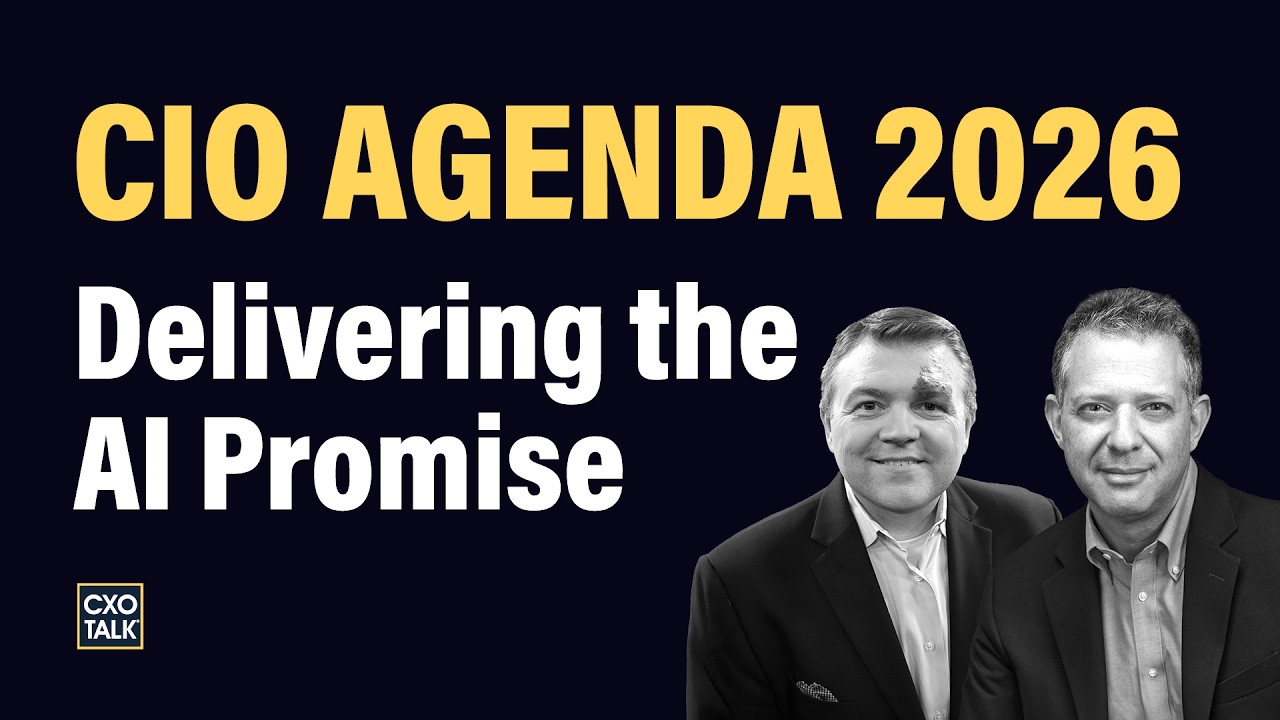 Watch on YouTube
55:43
Watch on YouTube
55:43 
Learn why most organizations struggle to generate measurable value from AI and what CIOs must do differently to deliver real business results in CXOTalk episode 909.


Related Episodes
Eighty-eight percent of organizations now use AI, yet only 5-6% generate measurable value at scale. The era of experimentation is over, and Boards expect Chief Information Officers to deliver AI value and demonstrate business impact.
In CXOTalk episode 909, we explore the critical gap between AI investment and AI results:
- Why organizations remain stuck in pilot mode
- The hidden cost of shadow AI initiatives that bypass IT
- What separates the small number of CIOs delivering real returns from the majority still searching for ROI
- The rise of agentic AI and whether organizations are prepared for autonomous systems
This is the year AI accountability gets real. Join this live conversation and learn how CIOs are closing the gap between AI promise and AI value.
Key Points
The AI Value Crisis Starts with Business Ignorance, Not Technology Failure
88% of companies use AI, yet fewer than 6% extract measurable value. The root cause is not technology. Many CIOs lack the intimate, ground-level understanding of their business operations needed to identify where AI will deliver meaningful outcomes.
Define Value Before You Deploy Anything
Too many AI conversations focus on cost, tools, and features rather than outcomes. Organizations need a product management function within IT that owns roadmaps and aligns every AI initiative with business outcomes that the entire leadership team agrees on.
Build Governance into Culture from Day One
Bolting governance onto AI projects after the fact guarantees failure. Winning organizations establish cross-functional AI councils from the outset and replace thick policy books with a short list of non-negotiables and clear decision-making principles.
Episode Participants
Tim Crawford is ranked as one of the Top 100 Most Influential Chief Information Technology Officers (#4), Top 100 Most Social CIOs (#7), Top 20 People Most Retweeted by IT Leaders (#5) and Top 100 Cloud Experts and Influencers. Tim is a strategic CIO & advisor that works with large global enterprise organizations across a number of industries including financial services, healthcare, major airlines and high-tech. Tim’s work differentiates and catapults organizations in transformative ways through the use of technology as a strategic lever.
Isaac Sacolick is the president and founder of StarCIO, a technology leadership company that guides organizations in developing digital transformation core competencies through its center of excellence, workshops, and coaching programs. A lifelong technologist, Isaac has served in startup CTO and transformational CIO roles. He founded StarCIO with the belief that agile ways of working, product management, and data-driven practices can empower diverse teams to drive digital transformation.
Michael Krigsman is a globally recognized analyst, strategic advisor, and industry commentator known for his deep business transformation, innovation, and leadership expertise. He has presented at industry events worldwide and written extensively on the reasons for IT failures. His work has been referenced in the media over 1,000 times and in more than 50 books and journal articles; his commentary on technology trends and business strategy reaches a global audience.
Related Episodes
In This Episode
Tim Crawford: If you are thinking, "I should have a seat at the table," you have failed. You have failed. You should be asking yourself, "How do I earn a seat at the table?" And the title does not get you there.
The AI value gap
Michael Krigsman: 88% of companies use AI, but fewer than 6% get measurable value. The pilot era of AI is over. Tim Crawford and Isaac Sacolick are both former CIOs and world-class CIO advisors. Tim, what's failing, AI strategy or IT execution?
Tim Crawford: Flatly, both. We're focused on the wrong thing. We're not thinking about the outcomes, and companies are suffering because of it.
Isaac Sacolick: If you flash back a year ago, every board, every executive committee want- didn't wanna fall behind in AI, and every tool became accessible, just like the mobile era. And so what you ended up with is lots of people in companies trying out AI, whether it was a large language model or an agent that appeared in a SaaS tool. And so all of a sudden, you got tenfold, twentyfold, sometimes a hundredfold more experiments undocumented happening inside the organization.
And so now the CIO is backtracking and saying, "We need to make sure there's a strategy here, that we're focused on the right things, and making sure that we have governance in place, so we know which tools, which teams, which data," and that all falls into where are we focusing our effort when it comes to AI?
Tim Crawford: And the reality is that the CEO is increasing the pressure on the CIO to produce the results, and the problem is they're not, and they're struggling through how to put their arms around it, how to connect the dots, what metrics to use. I know we're gonna talk about many of these things, so I don't wanna steal that thunder, but at the same time, the reality is we're in a tough spot as IT leaders, and we've gotta navigate our way through this.
Isaac Sacolick: Talk about metrics. I mean, the number one thing people have talked about coming out of AI is either productivity or efficiency. We've been terrible at having productivity measures. We don't agree on what they are, and efficiencies take time to materialize. So we're still looking at using AI to take what we're doing today and make it a little bit more efficient, a little bit maybe less error-prone at times. We're not at a point where we're taking AI and saying: How is it transforming our businesses?
What CEOs and boards want now
Michael Krigsman: Tim, you mentioned CEOs. So I'll direct this to, Tim, why don't I start with you, and then, Isaac, jump in. What do CEOs and boards want from chief information officers in 2026? Seems like it should be. I was gonna say that it seems like it should be kind of an obvious question, but is there uncertainty around this?
Tim Crawford: Yes and no. So the question still exists. The question is not new. They wanna take advantage of the new innovation. They wanna take advantage of AI. They know there's a there there. They just don't know what the there there is for them, and so that's where the real question comes up, is: How do you start to understand, kind of to Isaac's earlier point, how do you understand which of those efforts, which of those experiments, are actually gonna prove out something that is valuable to the business, that is gonna move the business forward, accelerate the business, achieve some of those business objectives that the board is outlining and the ELT is focused around?
Or are you gonna continue through this experimentation? And kind of to our earlier conversation in the last episode, talking about staying in this AI purgatory. That's where a lot of folks still are. So I think the number one thing that people have to understand is they have to understand their business, first and foremost, full stop. Forget about the technology for a minute.
Understand your business, because if you don't, you're gonna have a really hard time understanding where AI can apply, and how it's going to apply, and the output that it's going to achieve for your company and for your customers, and what's just another tech sh- bright, shiny object that you're putting in place.
Michael Krigsman: Isaac, I have to ask you something: How is it even conceivable that a chief information officer would not understand the business? And we're here to talk about AI, and why are we even talking about this?
Isaac Sacolick: Most CIOs will understand the business strategy, most. There's still a lot of CIOs who are being hired as operators, and still a lot of CIOs who see themselves as operators. But I think the bigger issue is, even when you have a CIO who understands what is in their quarterly, yearly filings to the street about where their growth is and where they're gonna find efficiencies, that doesn't translate down very well, and most of the work that we're doing around AI is a lot of bottom-up work.
It's a lot of, "What can I do as a marketer to become more efficient or to drive a campaign? How am I using AI inside my development tools to deliver features a little bit more reliably and a little bit faster?" Those are the things that we're doing, and there's a lot of layers of disconnect from business strategy around delivering value to customers or expanding what we're doing from a customer service perspective and what the individual teams and people are doing with AI today.
Tim Crawford: I actually wanna take exception to one thing that Isaac said. I agree with most of it, except for one thing, and that is that I don't believe that most CIOs truly do understand their business at the level that they need to. I think that they think they do, but in many cases, they have a layperson's understanding of how their business operates, and they need a much more intimate understanding of how their business operates. But otherwise, I completely agree with what Isaac said.
Isaac Sacolick: No, I agree with that, Tim. I mean, when I talk to CIOs, and we say: "How are you spending your time week to week, month to month, quarter to quarter?" And we break that down into percentages. If they're not spending time in the field with customers, in operations, on a factory floor, with their HR teams in terms of what types of struggles they're having, or marketing with how they're growing the business, if they're not actually spending real time with business teams and business leaders, then they're only gonna see things at a papers strategy level and very separated from how things are executing on the ground floor.
Why organizations stay stuck in pilot mode
Michael Krigsman: Let's hit directly on IT and AI. Why are so many organizations stuck in pilot mode with AI?
Isaac Sacolick: They're still learning the tools, is a big part of it. I mean, the tools are evolving so quickly, that if you ask a development team just 6 months ago: "How much productivity are you getting out of using a code generator?" The study showed about 20 to 30%, depending on what was the after effect of using that code generator.
And then a few months ago, vibe coding became the new set of platforms that development teams were using, and now they're producing applications with English and getting 60, 70, 80% of the way applications built out. And then if you believe what Anthropic is saying and what OpenAI is saying a couple of weeks ago, they're saying 100% of what they're doing at the coding level is now happening with AI.
And so a lot of CIOs and their teams are a little paralyzed by that velocity. If I even figure out something today that we think is worth taking out of pilot mode and getting a few more teams using it and seeing how we operationalize it, it might be evaporated in 3 to 6 months, that there might be another model that leapfrogs it, or maybe I'll be building less because a lot of my SaaS providers are already providing the functionality directly in their platforms. So there's a lot of uncertainty where CIOs have to really focus implementation in their AI strategies.
Tim Crawford: I completely agree. I mean, the velocity is way too fast for the enterprise to be able to consume, and so they're just skipping along the surface and hoping they can grab a hold of some of that value along the way. But it is creating a bit of consternation, and I say that lightly, although the reality is that it's creating a lot of consternation internally. Because the belief is, at least from those that are uninitiated or are not familiar with the technology or understanding how technology is used within the company, they think they can just drop this in and be able to use it quickly.
I wrote a post just recently and kind of outlined that I'm finding 2 swim lanes of success. One is you either have to bring this technology in a wa- and I mean AI technology specifically, you have to bring it in in a way that doesn't impede the way that people work, meaning they're actually using it, but they don't realize they're using it.
Or the alternative is you have to wrap it with training. You have to put the training effort in to help people understand, how does this change how they work? Why should they be using it? Not just, "Hey, here it is. Go to town, try and use it." What we're finding is that individuals within the company don't know what to do with it, and so that creates this gap between those that are having success and those that aren't.
Isaac Sacolick: Tim's hitting on one of the failure modes, one of the areas that IT traditionally struggles with, and that's in change management. So even when you have a pilot, and you think it's working, and now you're saying: "I'm gonna take it from one team in New York doing marketing and scaling campaigns with an AI behind it, and now I'm going to apply it in six other businesses or in four other departments across the world," I don't know how to do that very well. That's an entire ability to do change.
And the other side of it is, we're not really good at testing things. So you might have a team that says: "Hey, we have a pilot that's working," and CIO needs to know, is it reliable? Is it putting out valid results? Where is its boundaries, where we know the AI is providing incorrect results? Be able to test in a robust way and say, "This AI is release-ready," even to a pilot group, is a second area that we really struggle with.
Starting with the customer, not the technology
Michael Krigsman: This is really helpful, especially because you're focusing on the AI-specific set of issues, as opposed to just the broader set of CIO role challenges that have been basically unchanged for the last 25 years. You should subscribe to the CXO Talk newsletter, so we can notify you of upcoming shows. So go to cxotalk.com and just subscribe.
All right, let's take some questions, and the first question is from Chris Petersen on Twitter, and he says: "Is AI adoption still living in the inside-out world of starting with technology instead of starting with business
Tim Crawford: needs?" It is absolutely still stuck in inside-out thinking as opposed to outside-in thinking, and this is really where some of the best opportunities are coming from, is when you start to think about things, like in the CX space. You start to think about things from the customer-centric viewpoint, as opposed to what your agents are doing internally or what your staff are doing internally.
Think about it from the customer, whether that's an external customer, your company's customer, or an employee, if you're talking about support within IT or HR or finance. But absolutely, we have to change that vernacular. We have to change that viewpoint, and that gets back to understanding your business, understanding your customers, your stakeholders. How are they engaging with your company? What's gonna be meaningful for them? And that's really what's gonna drive the difference between success and failure, and we're already seeing examples of that play out.
Michael Krigsman: Isaac, here's a question from Arsalan Khan, and I think it's very directly related to what Tim was just talking about. And Arsalan Khan says, "We always ask CIOs to, quote, 'understand the business,' but why don't we have the same type of emphasis for non-technical executives to know about technology beyond just the hype, and now, especially with AI?"
Isaac Sacolick: That's a critical part of the CIO's job, particularly with boards and the executive committee. Setting realistic expectations without getting into how the sausage is being made. I mean, if you read all the hype that's out there about what we can do with AI, it sent Wall Street crashing SaaS stocks just a couple weeks ago, believing SaaS is gonna disappear and enterprise CIOs are gonna rebuild CRM and ERP platforms using vibe coding. It's just not gonna happen that way.
So CIOs need the right vernacular, the right storytelling, the right analogies to go back to their boards and their executive groups and tell them a little bit of what's important to be ready for AI as the technology changes. We need to have our data ready. What does that mean? Well, we need clear customer data. We need real policies about where they can be applied. We need a real testing methodology as we're rolling out pilots. We need a seasoned group of individuals who can lead change management efforts. Those are the kinds of things CIOs need to be communicating.
Earning a seat at the table
Michael Krigsman: This is from Simone Jo Moore, who says that CIOs have fought hard to get a seat at the table as chief, but still seen by other C-level leaders as, quote, "Let's pass an order to this area." Again, this seems very much relating to this attitude of IT as being separate.
Tim Crawford: I wrote a post quite a while ago now, several years ago, talking about the 3-legged race, and it hits on this very question, which is how people look at IT, but also how the IT leader kind of conducts themselves. And kind of to Isaac's point of how they conduct themselves amongst the ELT, as well as in the boardroom, assuming they have exposure to those environments. That's not always the case.
One thing that's important is to understand that just because you have the title doesn't mean that you have earned that title. And what I mean by that is that there are a lot of folks that. And this gets back to an earlier comment I made. Unfortunately, there are a lot of folks that have the CIO title but do not operate or are seen as a chief officer, similar to your CMO, COO, CFO, CHRO, CEO.
And so that's one thing that if you do have the CIO title today, you need to ask yourself: how can you operate at that level, at that strategic level, with that business insight? I often say that you have to be a business leader first that happens to have responsibility for technology, not the other way around. And that's a hard transition for a lot of these leaders to make.
But getting back to the 3-legged race, there are 3 aspects that you have to think about. One is how you conduct yourself as CIO. Number 2 is how your organization, how the IT organization, conducts themselves, and are they business-oriented all the way down to the most junior person on your team? And number 3 is: how do people perceive you outside in? So how do folks on the ELT perceive you? Are you the one that they call when the projector stops working, or are you the one that they're gonna bring into the open-ended conversation around where we take the company next?
And so you have to be able to navigate that. But the one thing that's really important is if you are thinking, "I should have a seat at the table," you have failed. You have failed. You should be asking yourself: how do I earn a seat at the table? And the title does not get you there.
You have to think about relationships. You have to think about how you earn that seat, and keep in mind, just because you get a seat at the table doesn't mean you get to keep a seat at the table, 'cause there's someone right behind you willing to take that seat, should you stumble.
From efficiency to real transformation
Michael Krigsman: Isaac, let's jump to another question. You can see I try to prioritize the audience questions over my own. So Isaac, Joseph Puglisi says the following. He says: "How do we move from introducing AI to improve efficiency or accelerate the current business to true business process reengineering or better total business transformation? How do we get the real value out of the promise of AI?"
Isaac Sacolick: Yeah, I've been telling CIOs that a lot of what AI is doing in their organization is reshaping its business. It's not really transforming yet. We're not really focused on customer experience. We're not really focused on growth yet. We're not at the things that are really going to evolve and make most businesses competitive for the next 3, 5 to 10 years.
Now, if you look at how winning CIOs have accomplished this, the ones that are truly innovative, they replicated this ten years ago, 15 years ago, off of what SaaS companies were doing and why they were successful. If you look at traditional IT, we were ticket-based in our history. Business came in with a ticket. We responded to the ticket. We measured how well we responded. Eventually, we started measuring employee satisfaction.
If you look at how a SaaS company operates, they have a function in there called product management, and product management says: "We're gonna look at what are the P&L objectives, what are the growth objectives, what markets do we wanna be in?" And they come up, in partnership with the technologists, what the roadmap should look like. What is the release strategy? Where do we need to experiment and do R&D with?
I did an article last year for CIO Magazine around product-based IT for that exact reason, because when you look at all this technology, the question about inside out, we need people in the business experimenting with how enterprise SaaS platforms are investing, are putting agents into their system. What do these things actually do?
And then we need to marry down top-down strategy that says, "You know what? In HR, we should focus on recruiting. In marketing, we should focus on campaign management. In IT, we should focus on AI operations and improving our ability to maintain our systems that improve stability." That's the strategy part, and what we need is a group of individuals inside our IT organizations called a product management function that's gonna own the outcomes. It's gonna prescribe, "Here are the roadmaps that are gonna get us to the strategy that we've outlined at the beginning of the year."
Tim Crawford: I mean, in a lot of ways, it's kind of shifting your organization to move from a project-oriented focus to a product-oriented focus.
Governance in an agentic world
Michael Krigsman: We have a great question from Derrick A. Butts, who says he thinks CIOs need to be in alignment with their CISOs to understand the challenges of the AI promise, along with the risk that will be introduced. How can CIOs prepare for the challenges and alignment of AI within their business culture and ecosystem when there is no CISO?
Tim Crawford: This kind of gets to one of the reasons why AI solutions are struggling. The more sensitive the data, and Isaac kind of talked about getting your data prepped, and you have to have it prepped better today with AI than ever before. It takes it to a whole new level of preparation.
But one of the other things you have to think about are the governance models that sit around that data and how agents, and especially as you move into an agentic world, and you start thinking about MCP, you start thinking about A2A, you start thinking about ephemeral agents, you have to start thinking about how those governance models start to play a role.
And so the risk, which is really where CISOs need to be focused, the risk associated with AI as opposed to the opportunity, is really causing some folks to say, "You know what? I'm only gonna use very specific aspects of AI because I don't know how to put those governance models in place." And to be fair, it's a really complicated problem because you have governance models for the user, what does Tim get access to versus Isaac when they engage with the agent, versus what the agent has access to, versus the knowledge base that the agents have access to.
Oh, and by the way, that data may not exist within a central repository, like your Snowflake repository or Databricks or whatnot. So it might sit in a system of record which has its own governance models, and so how do you start to rationalize that?
And the reality is it's a really hard problem, and this is why companies are starting off really small to get their arms around the data, put a governance model in place that they can control and manage and reduce the risk, and why they're not just running, what I call running with scissors, down the road and trying to do all these crazy things that people talk about in the press.
Michael Krigsman: Tyler James Johnson on LinkedIn says: "At what point does governance need to shift from reporting to real-time enforcement in order to safely scale AI?"
Tim Crawford: I think the question is: How do you start to put the right governance models in place? And this is where, number one, if you don't have an AI council established within your organization that is cross-functional, that has got to be the starting point. This is not an IT problem; this is a company problem, and so you're gonna need that cross-functional conversation to be able to understand then, what are those different layers, and how do you start to put those layers in place?
Isaac Sacolick: Tim took the words right out of my mouth. We have a long history of saying, "This group is responsible for strategy and innovation, and this group is responsible for risk management and security." It didn't work before. It totally falls apart when we think about AI. We need to be having that same group together. Your idea of a council is one way of solving for that, but don't embark on an AI experiment or a pilot or think about even putting into production without that group together.
We've been doing Agile for a very long time. We know how to solve for this. You put a multidisciplinary group together and say, "Look, we're not just trying to improve efficiency and productivity and get that value out of it; we're also require these attributes in terms of reliability, in terms of privacy, in terms of data bias," and put that all into the objectives of that group to accomplish all of it at the same time. I know it sounds simple, but that org separation is killing us.
Tim Crawford: Some of those AI councils, in fact, a number of them, are not actually led by the CIO or head of IT. They're led by the CEO or someone else within the executive leadership team. So don't think of it in the context of IT should be leading this effort or driving this effort. That's not necessarily the case here, again, because you need to start with that business context to be able to make the right decisions for how AI gets used, from governance to outcomes to risk.
AI is reshaping roles, not replacing people
Michael Krigsman: This is from Sagar Bhujbal, and Sagar says, it's a long question, so I'm gonna paraphrase this, but essentially, he's saying that the winners, AI winners, will be the ones who operational AI, and by understanding the way AI tools can accelerate workflows and decision-making speed while keeping judgment with humans, and laggards are letting AI replace thinking and outsource judgment.
So my question therefore is: How should technology leaders evaluate AI technologies in order to ensure that the tools are capable and map onto, say, innovation-related processes, as opposed to pure efficiency-driven outcomes?
Isaac Sacolick: Michael, a lot of what you're seeing in AI right now is helping a person, a specific role, accomplish a specific task. That's what an agent is doing inside all the major SaaS platforms, and they're starting to build up the skill set so that AI can accomplish a bunch of different skills for a particular area of responsibility, and that is a work in progress.
Another one of the big announcements over the last couple of weeks is just the explosion of how AI is being implied in legal and finance, so a top-down ability to replace a lot of different functions, and that's how organizational leaders. I like your point, Tim, that it's not just the CIO. You have to really look at the organization and really look at the process, 'cause we're not gonna take out just a step in the process or really, in practice, a role in the process.
We're gonna say, "What does this department need to do now that we have AI in place?" I saw a CIO speak about it six months ago, and he's now a CEO, and he questioned his HR department: "Why do we need an HR department if I have AI?" And so when you ask a question like that to the head of HR, you start unpacking what is the value an HR department is delivering that an AI isn't going to be delivered, and I think all organizations have to start thinking that way. By the way, I don't advocate not having an HR department.
Tim Crawford: I- I
Isaac Sacolick: think they're very important.
Tim Crawford: I mean, that's where I was gonna go. I mean, there's been a lot of cruff out there, talking about how AI is gonna replace people and replace the world. And will it? Well, maybe in some spaces, some specific roles or functions of roles, but this is not about. At least in this first horizon, 'cause there are 3 basic horizons or 3 fundamental horizons for AI, and we're still in this first horizon and still figuring it out, so there's a lot more opportunity to come.
But in this first horizon of efficiency, which is largely what we're all talking about, it's not about replacing people, but it's more about: How do you increase the value that each person in your organization delivers? And so what that's going to do is cause us to rethink how each of our functions operate from an organizational standpoint.
But again, kind of back to Chris's earlier question, you have to think from the outside in, what do your customers need? What do your customers want? What should they want? It's the Henry Ford adage: "If I ask customers what they want, they'd say faster horses." And look where he took things. We have to do the same thing here.
We have to rethink how we operate businesses, and so, yes, we're starting off very slowly, maybe too slowly in some people's minds, but that's a really important point to make, which is: How do you start to affect and then accelerate the process in which you're adopting this technology? And that's a really key point here, is we can no longer take this stance of bring a new technology in, then bring something else in and take this waterfall approach. Sorry, Isaac, I had to do a little Agile there. But the
Isaac Sacolick: reality
Tim Crawford: is-
Isaac Sacolick: you've got
Tim Crawford: got him to
Isaac Sacolick: laugh. I got
Tim Crawford: Michael to laugh. Yes. My goal is-
Isaac Sacolick: Twice
Tim Crawford: My goal is
Isaac Sacolick: accomplished.
Tim Crawford: But I think it's really important for IT leaders to understand that there is a velocity change, a market velocity change that your organization needs to take. That needs to start with IT, but it's gonna happen across the entire organization, and so how you do that, how you accelerate your organization, is really important.
Michael Krigsman: We have an interesting comment from our brilliant friend, Sarbjeet Johal, who says, "Titles and team sizes are all under reconsideration in this AI age," and I think this is speaking directly to the points you've both been making. AI is changing things up.
Isaac Sacolick: I think that's been happening for a while now. As we provide more technology capabilities, things that people had to do manually are being replaced by technology, and AI is doing a big piece of this. It's accelerating this, but it's really important for CEOs and boards to know that just because we're getting AI doesn't mean that we can release 10,000, 20,000, 30,000 people from our job force and making that correlation.
And you could see it at the lowest level. Even if I can do 100% of my coding in my department with AI, even if I can do that, I still need expertise to weigh in trade-offs. If I give a requirement to build a login system and it does everything in memory, maybe that's not gonna scale to hundreds of thousands and millions of users the way the AI system constructed it.
So I need people who need to be able to ask the question the right way, to realize it's worth developing something in the first place, that there isn't something out there that I can already reuse, to evaluate the conditions by which it responded, and that's going to happen inside every single function.
So that's a transformation at an operating level that's starting with some concrete roles right now that's going to expand, and it really comes back down to, again, being able to listen from our staff. Subject matter experts, how is this helping you today? And then having some top-down questions about how are we reorganizing around this capability.
Outcomes over tools
Michael Krigsman: Tim, we have a question from Jay Cohen on LinkedIn that gets right to the heart of something essential that I'd like to dig into, and Jay Cohen says: "Will CIOs need to shift from AI capability discussions to explicit value definitions?" And so my question to you, Tim, is why do we even need to ask? Shouldn't the CIO understand the value definition and have the ability to move beyond a discussion of tools and features? Or do CIOs, as a group, well, I'm not gonna say it. I won't-
Tim Crawford: I will say it. I mean, a CIO is not a CIO, is not a CIO, okay? And I'm happy to talk offline and talk more in depth publicly about this, but the reality is, yes, they absolutely should understand the value and the outcome, and not be focusing on the bright, shiny object.
I mean, this is the problem that we've had for decades, is there has been this over-rotation of focusing on the net new thing. And sometimes to the chagrin of others that are going: "Well, why are we doing this? How is this really kind of moving the needle for our business?" And the reality is, you have to look at this.
We actually see this happen in different conversations. So, for example, I was just involved in another conversation with a group of leaders yesterday, talking about cost. Talking about cost, specifically. And I said: "Why are we talking about cost again? The conversation should not be cost. It should be about value." Because what is value? Value is opportunity or outcome minus cost, and the value is what moves the needle, not the cost, and so it's important to understand that relationship.
And so, yes, we should be talking about the outcomes. Another way to think about this, Michael, in terms of AI, is if you truly are thinking about those outcomes, you kind of don't care what happens in the black box. It could be AI, it could be advanced analytics, it could be black magic. It doesn't matter. What matters is what's the input that I need to be able to get that output, and then the opportunity and risk equation that goes with it.
But the actual technology itself, sure, we need to know a little bit about that and understand that, and that gets to this point of trust, which is another key thing that's a problem for AI today. But at the end of the day, it kind of doesn't matter, and that's what we have to focus on, is the outcome, first and foremost.
Michael Krigsman: Outcome first and foremost. Let's talk about that in terms of agentic AI. What should CIOs do about agentic AI right now?
Isaac Sacolick: This discussion around value needs to be something that a CIO can have a collaborative discussion with their leadership team about what it is and how we're measuring it. If you have a conversation with your CMO and they say, "Our value is delivering more leads to sales," that's just not looking at a holistic picture.
One of the reasons we're having a hard time with this is that CIOs need to get at a real collaborative discussion with their groups about how to express value that the entire organization can wrap their hands around.
Now, when it comes to agents, okay, there are some folks who are gonna say: "We should be aiming at fully autonomous agents. They're gonna take over our organizations in different functions, and what we're really going to be doing is cutting back so that we can establish trust. So we're gonna design it for fully autonomous and cut back."
There are others who say: "We're never gonna achieve that fully autonomous, or it's gonna take a long time or a lot of expense to achieve that autonomy, and so we're gonna just look at it as human in the middle, human at the helm. How do we make people smarter, more efficient, more capable of doing the things that they need to do in their functions now that they have access to an AI language model, now that they have AI being able to answer a lot of questions proactively, now that we've connected all of our automation so we can have an AI explain trade-offs and connect the different things?"
And the answer is, we're gonna be doing a little bit of both of those for a while. It really depends on the value, where we start from, and the risk of that function. I don't think I want a fully autonomous surgeon anytime soon, even though somebody's gonna argue that that's perfectly capable.
But should I have a fully autonomous response to a set of systems going down that I've seen before, and having a fully autonomous way of diagnosing the issue and being able to respond to that, so it minimizes downtime, I absolutely should have agents that allow us to do that. So we're gonna be doing a little bit of both, and so the CIO needs to be looking at that agent from: What is it capable of doing? Where do I need people? And what's the risk equation around that particular function?
Tim Crawford: There's another piece to this, too, that they have to think about. I completely agree with what Isaac said. You have to understand where it's important to have the human in the loop, and you have to understand where it's important to take the human out of the loop. Because in a number of different spaces today, we have to be taking more humans out of the loop because our business is gonna require that.
Our competition, our adversaries. I mean, if you think about cybersecurity today, it is almost too slow in some functions to wait for a human to review a particular case, assess it, and then take action on it. By then, the damage is done. You need something that can identify, assess, and take action almost immediately, because each second counts.
Now, that's just cybersecurity, but there are other aspects of the business that this is true to as well. So I do think it's important to understand the balance between where it's appropriate to bring agentic in, and mind you, I am a huge proponent of agentic when applied appropriately. But the other piece to this is really understanding how it works and how to start bringing that automation in in an appropriate way, that you have the right balance of opportunity and risk.
Shadow AI and the innovation paradox
Michael Krigsman: What about shadow IT? So what is the impact of agentic AI on shadow IT? Is agentic AI creating a new wave or variant of shadow IT, and do we care, and what do we do about it if we do care?
Isaac Sacolick: It's another variant of something that has always existed inside IT and will continue to exist. As long as the tools make capabilities available, we're gonna be striding that way between what we want people to self-service and try out, what are some of the things that we don't want them to touch at all, and want to have no capability to purchase, acquire, use in any shape or form inside our enterprise?
And then there's a lot of gray area in between that is focused on context. I have the tool in place. I've signed up Copilot. I have a license for it. I said yes to it, but it's being used in a way that I probably don't want this to be used in that way.
One of the things that organizations are terrible at doing is marrying in that "I want to experiment," to "how do we capture the knowledge of that experiment and capture the ended result of that experiment." Should somebody be doing that experiment at all in that tool with that data? And if the answer is yes, how do we learn from it whether it passed, failed, or needs to continue on?
That's the missing gap that's always impacted shadow IT, and it needs to be addressed with shadow AI because it's our subject matter experts in their departments, using these tools, that are telling us what's working and what's not working.
Tim Crawford: And why are they telling us that? Because they're the ones that understand the business the best. They're the closest to the problem. And so you will end up with things like agentic sprawl, again, something else I've written
Isaac Sacolick: about.
Tim Crawford: But you're gonna end up with a number of these issues. I don't necessarily think that's a bad thing, but you have to make sure that you have the appropriate guardrails in place so that you're not creating undue risk for the organization.
Michael Krigsman: Well, there's a whole set of governance challenges that start to emerge. In a way, it's not much different from shadow IT in the past, where you had lots of people in departments buying SaaS products, using their credit card, and eventually, you can have fragmented data, you can bypass corporate compliance standards.
Tim Crawford: Those can also be great sources of innovation, too, and I think this is part of the problem, is: What is your orientation for shadow IT or shadow AI, and how are you encouraging or discouraging that? There are a number of IT leaders that flatly will say, "Shadow IT is a very bad thing for the organization, full stop." I personally don't agree with that.
I have seen opportunities or seen examples of the opportunities that come from those little experiments. And again, you've gotta put guardrails on. You can't just be the Wild Wild West and let everybody run and do whatever. So it's not living at the extremes of all yes or all no. There is a lot of middle ground there that is fertile opportunity, and when we start talking about AI, and now we're talking about something that requires, it's not an option anymore, it requires intimate understanding of your business, that's even more fertile.
And so we have to make sure that we, as IT leaders, put the right guardrails in place but encourage that innovation, because that's where those great beams of light are gonna come from, and the great opportunities.
Michael Krigsman: I think that shadow IT highlights gaps where IT and technology is not fulfilling a need, and therefore is a great, very fertile ground for discovering what folks in the organization need. But, Tim, the question then becomes, what kind of governance challenges do autonomous agents create? This is part and parcel of the shadow agent problem.
Tim Crawford: If you are thinking of how to put governance in place as a bolt-on, you will fail. But if you're thinking about how you put governance in place all the way from technology solutions to culture, so starting to change your culture and supporting employees to understand why these policies and why these governance models are actually there, you help them stay out of harm's way.
I mean, in most cases, folks that you look at what they do from a shadow IT perspective, and you go: "Why'd you do this?" And you dig into the reasons why. It's not because they're trying to be malicious against your organization or against the company, they're just trying to do something better. They're trying to get their job done.
They might go outside of the bounds of a particular policy, but let's be honest, at this point, most enterprises have so many policies on top of policies that nobody in the organization truly understands all of those policies, and that's a whole other bureaucracy problem that maybe we can start to use AI to kind of work through.
But I do think if you start with governance from the get-go, and it's cross-functional, you start to address some of these issues right out of the gate.
Michael Krigsman: Isaac, help us out here with some of these governance challenges, and what do we do about it?
Isaac Sacolick: The answer isn't just creating another book of policies. I mean, we need policies, but most people aren't going to read them, so we need to simplify some of the language around this. One way of doing that, I recommend CIOs, CISOs, come together and define some of the non-negotiables. Things that you're absolutely not going to do. You're not going to copy PII information out of your CRM system and paste it into an open LLM, and here's why. That is a non-negotiable, okay?
And then at some point, between non-negotiables and policies, there's a bunch of principles that we want to leave our organizational leaders and our employees with some good criteria for decision-making. I've put Excel out into my organization. Everybody has a copy of it on their desktop. If a single person's using an Excel to do a job for a single day or a single week to solve a problem, probably not an issue.
If that Excel grows into something 100 people have access to, that's being updated every single day and has all kinds of corporate information to it, maybe I'd be ought to be talking to IT about getting some help about operationalizing it. Those are things that you can codify in simple principles, 'cause ultimately, the boundary around shadow IT or shadow AI is, where do you want to give people direction, and where do you actually trust people to make good decisions?
The skills CIOs need to hire for
Michael Krigsman: I think we're talking about skills here. What kind of skills gap in IT has AI created, and what should CIOs do about that burgeoning skills gap that arises because of the growth of AI and agentic AI?
Isaac Sacolick: You've got to start with business acumen. I mean, you just cannot be an engineer or a developer sitting behind a screen and just focusing on executing your day-to-day job. It's got to start there. It's got to go on to critical thinking, being able to use any of the AI tools and be able to ask the right questions, and then evaluate the answers around that.
And if I needed to pick one single skill that everybody needs to have today, it's data skills. Because ultimately, that's what these systems are using. Being able to understand what data is being used to actually make a decision or what data is being used to support a recommendation coming in out of an AI, we need people to make independent evaluations around that.
Tim Crawford: Absolutely. Business acumen, critical thinking, critical thinking, critical thinking. That is so important. But the other thing that's important is curiosity, and these are things that you can't necessarily teach, but you absolutely should be hiring to. The ways that I've been advising companies and the ways I've done it in my organization is hire to the soft skills. You can teach the hard stuff all day, all night. You can teach about data. You can teach about technology.
Getting people to be more curious and understanding where their inspiration comes from, that's quite a bit harder to go down, and you have to ask yourself: Am I really gonna put the energy in to really expound upon that?
But the other thing is encouraging people and creating a culture within your organization that helps them understand how they can be inspirational and tap into that curiosity that they already have. For decades, we've been hammering people down and just knocking them down, right, left, and center, and not giving them the right tools and capabilities for them to really shine. We need that now more than ever, because the people is what's gonna help us differentiate, even in the era of AI.
Michael Krigsman: And on this topic, we have a question from Lisbeth Shaw on Twitter, who says: "How can you apply lessons learned in AI pilots to new AI initiatives and pilots, even if it's understanding what not to do?" So the learnings, and this gets to the culture as well. Isaac, you want to jump into this one?
Isaac Sacolick: Yeah, it comes back down to basic scientific methods that we've learned in schools that we often forget about. Say what your objective is, say your approach, be disciplined about executing against that approach, logging the outcome of that one approach, and then pivoting and saying, "What are we doing next?" And sometimes that's going deeper into the solution that you went into. Sometimes it's saying, "You know what? We're going in a completely different direction."
We now have some amazing tools with AI to dissect and to interpret all of that information, but we have to get our organization to know that just tinkering with the tools isn't good enough. Knowledge sharing, knowledge capture, training, teaching, even marketing our successes are all things that we want our leaders doing so that we continue to evolve how we're using these different AI capabilities.
Traditional CIOs are drowning
Michael Krigsman: Tim, many CIOs are just surviving, being able to execute their typical IT functions, let alone being able to drive new, complex AI initiatives. Are these folks mortgaging their organization's future and sabotaging their own careers?
Tim Crawford: Yes. Unfortunately, yes. I mean, this is really the difference between the traditional and the transformational CIO. The transformational CIO is gonna have that more under control and have a plan to get them from where they are to where they need to be. The traditional CIO is drowning, absolutely drowning.
They can't get beyond the, everything from the technical debt, all the way through to, "How do I start to introduce innovation into my organization?" To bringing this full circle to where we talked about, the 3-legged race. How do I get others to view me and my organization, me as the IT leader and my organization, as a strategic function as opposed to a cost center?
And that takes work. The trains have to go on time. You have to do that, but at the same time, you have to quickly understand, do I have the right players on the team? We've talked about this for years and years. Do we have the right people in the right seats on the bus? Do we have the right people on the bus? Do we even have the right stinking bus?
I mean, there's a lot that has to come into play, and it goes all the way to the IT leader. The way that I led IT many moons ago doesn't apply today. So we have to think differently about how we work as a leader. If I were to step into an operational role today, I would work very differently than how I would've worked even 10, 15, definitely 20 years ago, and that change, that switch, hasn't happened yet.
But that will actually help folks start to understand what is important, what is not important, and if it's not important and not moving the needle for the business, why are we still focused on it? I mean, there are so many sacred cows, or perceived sacred cows within the IT organization. "Oh, we can't touch this because of X and Y and Z." Guess what? If it's not moving the needle, out it goes. We don't have time for that. We gotta move on, and so there are some hard decisions that have to be made here.
What CIO greatness looks like
Michael Krigsman: Isaac, given all of this, what does CIO greatness look like today? Very quickly, please.
Isaac Sacolick: I did an article on CIO and did the keynotes on this last year. What does a world-class IT organization look like in the GenAI era? Well, we've covered some of these things. They're bringing AI strategy and governance together. They're putting product management at the forefront of their organization so that they can drive real decisions around roadmaps and outcomes.
Another big thing I've been writing about, Tim just said it, the operating model that worked inside IT 3, 5, 7 years ago needs to get rewritten. We have new tools in IT that's gonna change every single one of the functions that we have. So what we called Agile, what we called DevOps, and what we called data governance, data operations, that all needs to change.
And then I wanna end with just, Tim, operating CIOs, we've had them for a very long time. There are periods in certain industries where you can get away with that, and there are periods where, in certain industries, CEOs can't get away with that. If you roll back to the early 2000s, if you were in retail, if you were in media, B2C, and you had an operating CIO working there, you were in trouble 'cause the entire customer experience and business model was changing. I was part of that.
If you are here 2026, every industry is going to be disrupted with AI, and if you have an operating CIO who is just focused on productivity, and efficiencies, and reliability, you're just not gonna get there.
Michael Krigsman: Tim, in a tweet-sized bite, what does CIO greatness look like today?
Tim Crawford: It's focused on trying to become that transformational CIO that is very much business-oriented first, that happens to have responsibility for technology. Focus on what is gonna move the needle for your business, and figure out how to jettison the rest of it.
Michael Krigsman: All right, and with that, Tim Crawford and Isaac Sacolick, thank you both so much for being here. I'm so grateful that you're sharing your wisdom and your expertise with us today.
Tim Crawford: Glad to be here. Thanks again, Michael.
Isaac Sacolick: Always great, Michael, and so glad to see you laughing.
Michael Krigsman: And everybody who watched and who asked such great questions, thank you. Now, before you go, subscribe to the CXOTalk newsletter. Go to cxotalk.com. We, as I always say this, but it's really true, we have incredible shows that are coming up, and you guys in the audience make it. You guys are amazing. So subscribe to the newsletter. We'll update you on when we have shows coming up, and we want you to join us.
Have a great day, everybody, and we'll see you again next time. Thank you.